

Don’t Miss the Longest Eclipse of the Century
On August 2, 2027, the sun will go dark over South Portugal.
Experience the Solar Eclipse safely with Sol & Salvo.
The Gold Standard in Eye Protection
Standard sunglasses block 0% of eye damage. Sol & Salvo viewers are engineered to block 100% of harmful UV/IR radiation and 99.999% of intense visible light.
✅ ISO 12312-2 Certified: Meets international safety standards for direct solar viewing.
✅ CE Marked: Fully approved for the European market.
✅ Family Safe: Adjustable frames fit adults and children perfectly.
Best sellers


Discover the nearest Sol & Salvo partner in your district.
At the moment we work on partnering with store owners to sell the Sol & Salvo products.
We offer the best product with 100% risk free possibilities contact us for more details.

Where Will You Be When The Sun Goes Dark?
On August 2, 2027, Portugal will be divided into two zones.
Understanding your location is the difference between seeing a "Crescent Sun" and experiencing almost total darkness.
The path of Totality vs. Partial Eclipse The area where you are located will make all the difference.
In the path of totality, the Moon will completely cover the solar disk for few moments, creating a rare experience: the sky darkens, the temperature drops, and stars and planets may become visible. Outside this path, the eclipse will be partial. Even so, it will be an impressive phenomenon—but it will require certified eye protection throughout the observation.

Location Obscuration Sun height Notes
Faro (Algarve, closest to path) ~99.27% Best view in Portugal —almost-total
Funchal (Madeira) ~96.98% 26°
Lisbon ~92.58% 35°
Tomar ~ 89.09% 35°

What is The Risk ?
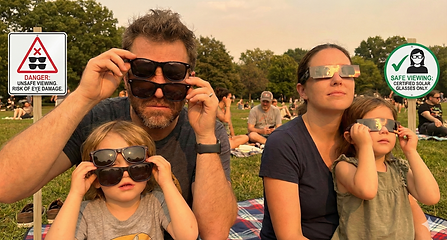
Looking directly at the sun without specialized filtration causes solar retinopathy—permanent photochemical and thermal damage to the retinal tissue. Because the retina lacks pain receptors, severe damage can occur in seconds without any immediate discomfort or warning signs.

How to Watch Without Risk ?
Your eyes are your most precious asset. Here is the science of safety. The ISO 12312-2 Standard of Sol & Salvo glasses are not toys; they are scientific instruments. They contain a specialized polymer film infused with carbon particles that filter out 100% of harmful ultraviolet and infrared rays. Myth: "I can stack two pairs of sunglasses." -> FACT: No. This is still thousands of times too bright and will burn your retinas. Myth: "I can use X-Ray film or smoked glass." -> FACT: Dangerous. These materials let invisible IR radiation through, cooking your eye without you feeling pain.
User Instructions
-
Inspect: Hold glasses to a light. If you see pinholes or scratches, discard them.
-
Wear: Place them on your face before looking up.
-
Observe: Enjoy the view! For comfort, take frequent breaks.
Do not view continuously for more than 3 minutes.
-
Remove: Look down or away from the sun before taking them off.
-
The Golden Rule: If any part of the sun is visible (even 1%), you must wear the glasses!!!

The different types of eclipses OR Why not all eclipses are the same?
The different types of eclipses OR Why not all eclipses are the same? The distance from the Moon to Earth and the exact alignment determine the type of visual spectacle: Total Solar Eclipse: The "king" of eclipses. The Moon covers the entirety of the solar disk. Day turns into night for brief moments, allowing the solar corona (the Sun's outer atmosphere)—usually outshined by intense light—to be seen. Partial Solar Eclipse: The Moon "takes a bite" out of only a part of the Sun. The visual result resembles a glowing crescent. Annular Solar Eclipse: Occurs when the Moon is farther from Earth in its orbit and appears smaller in the sky. It cannot cover the Sun completely, leaving a spectacular "ring of fire" visible around the lunar silhouette. Hybrid Solar Eclipse: The rarest of all. Due to the Earth's curvature, the eclipse can appear total in some locations and annular in others during the same event. The Frequency Mystery: Why Don't They Happen Every Month? The answer lies in the tilt. The Moon's orbit is tilted by about 5 degrees relative to Earth's orbit around the Sun. During most New Moons, the Moon's shadow passes too "high" or "low" and misses the Earth.Eclipses only occur during so-called "eclipse seasons," which happen approximately twice a year, when the orbital planes intersect.


Don't Burn Your Smartphone Sensor:
A guide for Solar Eclipse Smartphone Photography
Yes, the Sun Can Destroy Your Camera Just like a magnifying glass burns an ant, your camera lens focuses the sun onto your delicate digital sensor. Pointing your phone directly at the sun without a filter can permanently ruin your camera.

The "Sol & Salvo" Hack":
The Filter: Tape a spare pair of Sol & Salvo over your phone's camera lenses.

No Flash: Turn your flash OFF. It cannot illuminate the moon!Lock Focus: Tap and hold your screen on the sun to lock focus/exposure.Exposure: Drag the brightness slider down to reveal the sun's shape.

Use a tripod !
As the light fades, your camera will try to keep the shutter open longer, making handheld shots blurry.

For Photography with DSLR/Mirrorless Cameras go to this guide

Frequently Asked Questions:
-
How do I know these eclipse glasses are safe for direct solar viewing?
All of our eclipse viewers comply strictly with the international safety standard ISO 12312-2 (often written as ISO 12312-2:2015 / EN ISO 12312-2). This standard specifies that filters must block: 100% of harmful ultraviolet (UV) radiation 100% of harmful infrared (IR) radiation 99.997% of intense visible light (reducing solar intensity by a factor of roughly 32,000) Our glasses are sourced exclusively from recognized, accredited manufacturers and tested in independent laboratories to ensure full compliance before reaching your hands.
-
Anyone can print "ISO 12312-2" on cardboard. How can I spot a counterfeit?
ACounterfeiters frequently copy certification logos without using certified filter material. To verify authenticity, look for these key indicators: Clear Manufacturer Traceability: Real certified glasses will always state the manufacturer's actual business name, registered trademark, and contact address directly on the inside arm—not just a generic "Made in..." stamp. Recognized Supply Chains: Legitimate brands are verified by international astronomical bodies (such as the American Astronomical Society’s Solar Eclipse Task Force). We only stock brands listed on official registries of reputable manufacturers. Lab Verification: Reputable retailers provide access to testing certificates from certified accredited testing bodies upon request.
-
How can I perform a quick "At-Home Test" before the eclipse?
Before pointing your glasses at the sun, test them indoors and around ordinary light sources: In an ordinary room: Put the glasses on. You should see absolutely nothing—no walls, furniture, or normal room lighting. Everything should be pitch black. Near bright lamps: Look at a bright household LED, halogen bulb, or a smartphone flashlight held close. The light should appear extremely dim, soft, and comfortable to look at—not glaring or bright. If you can see everyday objects or ambient room details through the film, do not use them. The filter is dangerously transparent.
-
Can I use multiple pairs of regular sunglasses instead?
No. Absolutely not. Even stacking three or four pairs of high-end, polarized, UV400 sunglasses transmits far too much visible light and does not adequately block infrared radiation. Certified solar filters are thousands of times darker than the darkest consumer sunglasses. Only purpose-built solar filters meeting ISO 12312-2 are safe.
-
What should I check for if my glasses are bent or scratched?
Always inspect your lenses before putting them on: Hold them up toward an ordinary room light (not the sun) and look for pinholes, punctures, tears, scratches, or separation from the paper frame. If you see any light leaking through tears or peeling seams, discard the pair immediately. Even a tiny pinhole can focus harmful rays onto your retina.
-
Can I use these glasses while looking through binoculars, a telescope, or a camera lens?
Never. Do not look through an optical device (camera, binoculars, telescope) while wearing eclipse glasses. The optical lenses concentrate the sun's rays into an intense beam that will burn a hole through the filter material in a fraction of a second, causing immediate eye injury. To view or photograph the eclipse through optics, you must use specialized front-aperture solar filters mounted securely on the front (objective lens) of the device.
-
Can I wear them over my prescription eyeglasses?
Yes. Put your prescription glasses on first, then place the eclipse glasses over them, ensuring your eyes are completely covered and shaded before looking up toward the sun.